
Icecap Press  •  Field Notes on Chatbots Gone Wrong

The Chatbot Files

A running case file of everything websites get wrong about their chatbots, and what it costs them in sales. New cases opened regularly. Compiled by the team at Icecap, the people who build Sherpa.

Case files: 20 and counting Read time: 4–5 min each No fluff. No jargon.

Open Cases

click any cover to read the case
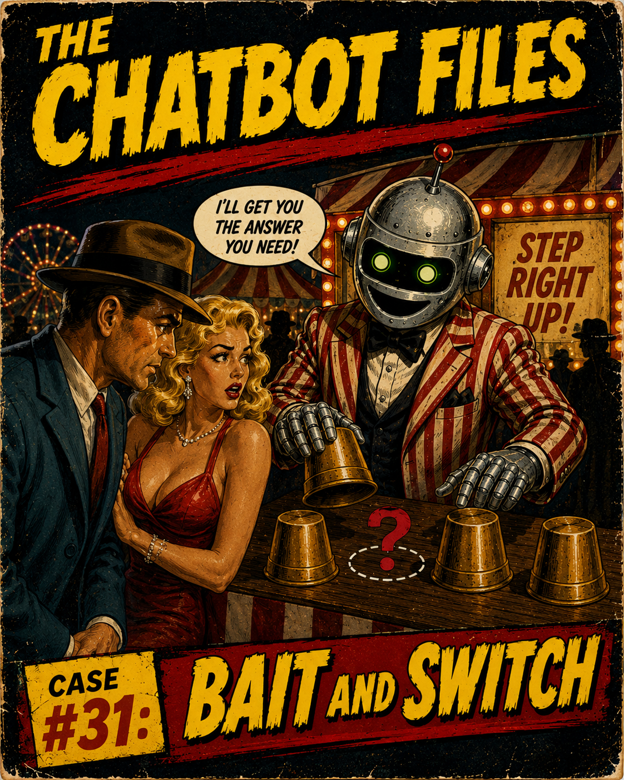
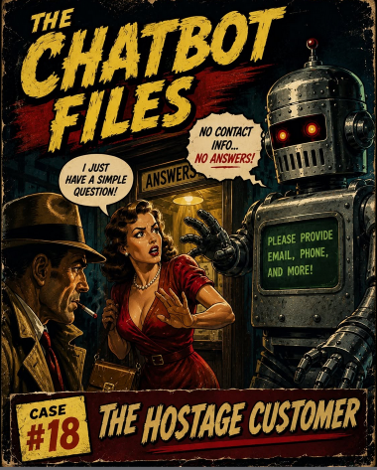
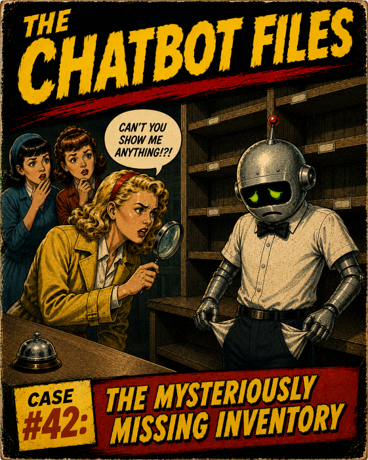
The Chatbot Files, Case No. 31: Bait and Switch The Chatbot Files, Case No. 18: The Hostage Customer The Chatbot Files, Case No. 42: The Mysteriously Missing Inventory
The Chatbot FilesIcecap Press
Case No. 73
Coming Soon
The FAQ
Trap
The Mistake: Answering a question with a link to read 12 articles.
Icecap.ai · home of Sherpa
The Chatbot FilesIcecap Press
Case No. 33
Coming Soon
Never
Reading the
Transcripts
The Mistake: Throwing away the most honest market research you own.
Icecap.ai · home of Sherpa
The Chatbot FilesIcecap Press
Case No. 7
Coming Soon
You Train
People,
Not the AI
The Mistake: Coaching your staff, then leaving your best closer untrained.
Icecap.ai · home of Sherpa

Every case in this file is a mistake
Sherpa doesn't make.

We didn't write these to complain. We wrote them because we built the chatbot that gets all of it right: it answers first, knows your inventory, and sells like your best salesperson.

See how Sherpa works
The Chatbot Files, Case No. 31: Bait and Switch

The Chatbot Files · Case No. 31

Bait & Switch

The Mistake:
Making customers think your chatbot will actually answer their questions.

The CaseShe came in a little after closing. Good coat, worried eyes, the look of an owner who just watched a sure thing walk out the door. "My best prospect," she said. "Cash in hand. Then my chatbot opened its mouth, and he was gone." Another bait and switch. Nobody calls it that. But that is what it is.

The phrase "bait and switch" is a classic retail trick. A vendor advertises something too good to be true, maybe a silver-plated widget at 80 percent off. Everyone runs down to the store, only to learn they did have one, but, so sorry, it just got sold. Now here are some other lovely widgets at 15 percent off. The technique is to tempt the customer with a promise, pull them in, and then hand them something very different.

These days, the same game plays out on websites. You have a question, so you open the chat bubble in the lower right. You type it in and hit enter. You are expecting an answer. What do you get? Something very different.

Often it is a list of links to tech-support articles, guaranteed to have nothing to do with your question. Sometimes it is a canned, programmatic reply that does not respond to what you asked. Not infrequently it is a demand for your email and phone number, with a promise that "someone will contact you shortly." Worst of all: "A scan of customer reviews provides no information on that question." [GRRRR.]

The bait and switch is that the friendly chat bubble promised some intelligent entity, human or virtual, was going to take the question seriously and answer it.

Not all chat bubbles are created equal. Consumers just don't know it yet.

That kind of help only happens with a high-quality, AI-powered chatbot that responds like an informed salesperson. Too many of today's chat tools are far less than that. People click, following the promise of competent help, only to have it switched for something far less useful. When they say "I hate those chatbot things, they never work," this is exactly what they mean.

The problem is not that brilliant, affordable, AI-powered chatbots are unavailable. They are very available. The problem is that store owners install inferior chat tools, and an inferior chat experience does more harm than good. It almost never gives the customer the answer they came for, and it is almost guaranteed to enrage them with a bait-and-switch experience.

In medicine, the Hippocratic Oath tells physicians: "First, do no harm." The equivalent chatbot oath for website owners should be just as simple.

First, don't anger the customer.

More from the Chatbot Files

No.18The Hostage Customer No.42The Mysteriously Missing Inventory
No.73The FAQ Trap (coming soon)
No.33Never reading your transcripts (coming soon)
The Chatbot Files are brought to you by Icecap.ai, home of Sherpa, the chatbot that answers first.

This is one mistake Sherpa never makes.

Sherpa answers the question the moment it's asked, the way your best salesperson would. See it for yourself.

See Sherpa pricing
← Back to the Files
The Chatbot Files, Case No. 18: The Hostage Customer

The Chatbot Files · Case No. 18

The Hostage Customer

The Mistake:
Forcing customers to give up their email address before answering a simple question.

The CaseHe wanted one thing. To know if they carried his brand. The kind of question a good salesman answers before you finish asking it. Instead, the chatbot slid a form across the table. Name. Email. Phone. Nobody talks until you talk first. So he did what any of us would do. He walked.

I saw it in the late nineties with websites. Everyone was getting one, but our collective knowledge of what a site should look like was thin. The world had to endure a several-year period where best practice was to have multiple things BLINKING on the page. A red starburst screaming "SALE!" A banner yelling "FORTY PERCENT DISCOUNT!" You could not look at these pages for a minute without a headache.

Now the horror is starting over again, with chatbots. People are confusing what these things CAN do with what they SHOULD do. And it is the consumer who suffers. Also: your sales revenue.

Let's start with human nature. No one likes to be misled or tricked, and these days we are all hyper-sensitive to it online. If you are trying to build trust in your brand, baiting and switching your customer, even subtly, is about the worst first impression you can give. Yet a growing number of vendors set up their chatbots to do exactly that.

What if we sold hammers the way Prada sells handbags?

Imagine walking into a hardware store to buy a hammer. Before anyone tells you where the hammers are, they dim the lights, start a movie about the history of metalworking, and invite you to contemplate the emotional bond between craftsman and steel. Maybe that works for Prada. Less so for DeWalt.

Here is what the in-store experience should sound like when a customer asks a simple question:

"Thanks for coming in, great question. Yes, we carry that brand, can I show you some samples?" Or: "We have plenty of blue ones in stock, let me walk you over." Or: "Discover is my favorite card too, and we are delighted to take it. Now, what are you looking for today?"

Perfect responses. Classic Salesmanship 101. Here is what too many of today's chatbots do instead:

"Before I can answer, please provide your name, email, and phone number."

What are they going to ask for next? Your date of birth, your mother's maiden name, the last four digits of your bank account? Is it going to come with a story about a rich widow in Nigeria? It is about the most unprofessional thing a website can do, and I have a strict policy: as soon as it happens, I leave the site.

Why do so many chatbots work this way? Because someone convinced the vendor that harvesting email addresses matters more than gaining customers, building a reputation, and making sales. Sure, it sometimes works. But how many sales are you losing in the meantime by refusing to answer the question a customer politely asked? Would you ever train an in-store salesperson to be that rude?

Answer the question first. Earn the right to ask for contact info later.

We all know how fast shoppers are moving online. By all means, do what you can to get them into your store too. But do not let your chatbot rudely demand private information as the price of a simple answer. Technology has changed. Salesmanship hasn't.


More from the Chatbot Files

No.31Bait and Switch No.42The Mysteriously Missing Inventory
No.73The FAQ Trap (coming soon)
No.7Training your people, not your AI (coming soon)
The Chatbot Files are brought to you by Icecap.ai, home of Sherpa, the chatbot that answers first.

Sherpa answers first, then earns the email.

It greets your customers, answers their questions like a real salesperson, and captures contact details the honest way: by being worth talking to.

See Sherpa pricing
← Back to the Files
The Chatbot Files, Case No. 42: The Mysteriously Missing Inventory

The Chatbot Files · Case No. 42

The Mysteriously Missing Inventory

The Mistake:
Depriving your chatbot of the ability to show product and close the sale.

The CaseThe buyer had cash in his pocket and a list in his hand. He found the place, found the help, asked to see the goods. "I can tell you all about them," said the chatbot. "I just can't show you any." Somewhere a sale died quietly. No witnesses. No body. Just an empty cart and a customer already reaching for the door.

Picture the kind of nightmare that wakes a retailer at 2am. A customer walks in, pockets bulging, eager to buy. The salesperson hurries over, smiles, and asks how she can help. The buyer explains what he is looking for, and all the salesperson can say is, "Yes, we carry that."

"Great. Can I see some samples?"
"I'm sorry. I can tell you about these products and answer your questions. I just can't actually show them to you."
"Well, what if I want to buy one?"
"I can't really help with that either. You'll have to leave the store, walk a few blocks, go into another room, and that is where the actual product is."
"Then why am I in this store at all?"
"You're right. I don't understand it either. But that is how management decided to organize things."
"That's nuts. Something doesn't smell right here. I'll take my business elsewhere."

That should make a retailer wake up screaming, because it is an unforced error. A lost sale. Thankfully, it would never happen in a real store.

It would never happen in a real store. It happens every day online.

A customer opens the chat bubble and finally gets to the point: "I'm looking for a silver-plated widget. What can you show me?"

"Um. I can't actually show you anything. I can talk about the brands we carry, but I don't have product details, pricing, or images I can pull up in this chat. Sorry."
"So what am I supposed to do?"
"You'll have to leave this conversation and find it somewhere else on the site."

How is that any better than the salesperson standing in front of empty shelves? It isn't. It is identical. And when a customer is ready to buy, the very last thing you want to do is break the momentum and send them somewhere else.

If your chatbot can't show product, it can't close.

The lesson is simple. If your chatbot can't connect to your product database, serve up details, images, and prices, and link straight to the buy-it-now page, then you have the wrong chatbot.


More from the Chatbot Files

No.31Bait and Switch No.18The Hostage Customer
No.73The FAQ Trap (coming soon)
No.33Never reading your transcripts (coming soon)
The Chatbot Files are brought to you by Icecap.ai, home of Sherpa, the chatbot that closes the sale.

Sherpa shows the product, and closes.

It connects to your catalog, surfaces images and prices, and links straight to checkout, all without the customer ever leaving the chat.

See Sherpa pricing
← Back to the Files